Can Brain Games Help Kids With ADHD Focus? What Parents Should Know
A child can remember longer strings of digits and still lose their place during homework. Here’s what research says about that gap, how to choose a game your child enjoys, and how long to play.

Your child remembers six digits in a game. Last week, five was a stretch. Ten minutes later, you ask them to put their homework in their folder and the folder in their backpack. They put the worksheet away, zip the backpack, and leave the folder on the table.
How can both things happen on the same afternoon? Remembering six digits is a real achievement. Whether practice in a brain game helps a child with ADHD pay attention during homework or in class is a separate question. Research on structured cognitive training has found gains on working-memory tasks. Evidence for broader improvements in everyday attention is much more limited.
What changed when your child remembered six digits?
Ask your child how they remembered 582941. Perhaps they heard three pairs: 58, 29, 41. Perhaps they whispered the digits until it was time to enter them. Either answer tells you more about their progress than the score alone. They found a way to hold that sequence in mind long enough to use it.
Now look at the backpack task. The instruction arrives while your child may still be thinking about the worksheet. They have to shift to packing, keep track of two steps, and notice whether the folder actually made it into the bag. A digit game gives them a clear signal to start and immediate feedback when they finish. A folder left on the table gives no feedback at all until someone spots it.
That difference matters when choosing what to practice. If the folder is the part that keeps getting left behind, try asking your child where they could put it before they start packing. They might choose to lay it across the open backpack. The next morning, you can both see whether their idea helped with the problem they wanted to solve.
What did researchers find when they tested brain training?
A 2023 review combined 36 randomized trials of computerized cognitive training for people with ADHD. Seventeen trials focused on working memory. The researchers examined several outcomes separately, including memory-task performance, ADHD symptom ratings, reading, and arithmetic. That distinction makes the findings useful to families. Westwood and colleagues, Molecular Psychiatry
Working memory showed the clearest short-term gains. Compared with control groups, participants improved on tasks involving verbal information and visual or spatial information.
The change in inattention symptoms was small. The effect was larger when attention was assessed in the setting where training took place. Among assessors judged unlikely to know which group a participant was in, the review found no clear immediate improvement in overall ADHD symptoms or hyperactivity and impulsivity.
Better memory scores did not consistently carry over to schoolwork. The review found no clear immediate benefit for reading or arithmetic. A smaller set of follow-up studies suggested some later gains, including in reading comprehension, but relatively few trials measured those outcomes.
These trials studied structured training programs. They don’t establish that playing a particular BrainMinis game will change a child’s ADHD symptoms.
If your child stays absorbed in a puzzle they chose, you’ve learned something worth knowing: this particular challenge held their interest today. To find out how they’re doing in class, ask about a concrete classroom task, such as getting started on independent work after the teacher gives directions.
Which kind of game should we try?
Choose according to what your child would enjoy doing with you today. In one round on Brain Minis, your child can hold a code in mind, wait for a signal, or find a way to make 24. Which of those sounds like fun to them?
If your child enjoys… | Try | A question to ask after one turn |
|---|---|---|
Secret codes and number patterns | Number Memory. Take turns remembering a sequence. Let your child hear how you group the digits on your turn. | “When the digits disappeared, which part could you still hear?” |
Waiting for a signal and catching you tapping early | Quick Reaction. Let your child watch you play first. Give them permission to call out your false start. | “What did you see just before my finger moved?” |
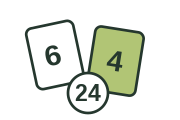
Moving pieces around and explaining an idea | Make 24. Write 2, 3, 4, and 6 on slips of paper. If your child spots 4 × 6, let them work out how the two spare numbers could make 1. | “Which two slips would you like to keep together?” |
An early tap can start a conversation about the signal. It can’t tell you how well your child controls impulses through a school day. Likewise, a child who dislikes recalling digits may happily spend an afternoon inventing puzzles for someone else. Let that preference guide the next choice.
How many minutes a day?
There is no established daily dose of ordinary browser games for improving ADHD symptoms. The review above doesn’t give families a reason to prescribe ten, fifteen, or twenty minutes of these games a day.
For family play, try one turn each. If it helps to put a time on the calendar, leave about five minutes for that first session. Five minutes is a planning example. A three-minute game your child enjoyed is a perfectly good place to finish.
Agree on the ending before the first move. “You give me a code, then I’ll give you one” works well because both players know whose turn is last. For a puzzle that might take longer, offer a way to pause: “When dinner is ready, we’ll write down the move you want to try next.” Tomorrow your child can decide whether that move still interests them.
What if homework is the reason we started playing?
Keep track of the difficulty you actually want help with. “On Monday she followed the first direction and missed the second” gives a teacher or clinician something specific to discuss. A screenshot of a game score answers a different question. If attention difficulties are getting in the way of school or family life, bring examples from those settings to your child’s healthcare professional. ADHD care can include parent training in behavior management, classroom support, and medication, depending on the child’s age and needs. CDC guidance on ADHD treatment.
And if your child comes back to announce, “I got seven digits this time,” enjoy that moment on its own terms. Ask how they kept the seventh digit in mind. They may have a trick they’ve been waiting to teach you.
If your child prefers pictures, Pattern Memory offers another way to see what a game asks of them. Once the highlighted squares disappear, your child can select the remembered positions in any order. Getting those places right tells you about that grid. For a worked example of what to look for at the kitchen table, read how to tell whether a game strategy carries over to homework.