Memory, Reaction, or Logic Games: Which Should My Child Try?
Does your child want to crack a code, catch a signal, or figure out a puzzle together? Compare three BrainMinis games and see what each one asks a player to do.

“What kind of game do you want to play?” can be a surprisingly hard question for a child to answer. Try offering three possible jobs instead: “Do you want to crack my secret code, catch me moving too soon, or help me get four numbers to make 24?”
Each invitation gives your child a picture of what their turn will feel like. That’s a useful place to start, including for families choosing games for a child with ADHD. Two games can both ask a player to pay attention while feeling completely different to play. One asks you to hold on to something that disappears. Another asks you to wait for something to change. A third lets you leave everything in view while you work out your next move.
Choose memory for a child who likes cracking codes
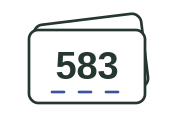
Try this before opening Number Memory on BrainMinis. Write 5274 on a slip of paper. Let your child look, cover it, and ask for the code. Then hand over the pencil so they can set a code for you.
Notice which part your child wants to do again. If they say, “Give me another one. This time I’m going to say it in pairs,” the digital game gives them fresh sequences to try that idea on. If they spend their whole turn inventing a particularly sneaky code for you, stay with the paper version a little longer. Being the puzzle maker may be exactly what appealed to them.
A memory game has one distinctive demand: the information goes away before the player can use it. That can make the reveal exciting. It can also make a child feel rushed even when there’s no clock to beat. If your child keeps asking, “Can I see it while I work?”, try a logic puzzle where the numbers stay on the table.
Choose reaction for a child who likes a clear signal
In Quick Reaction, the rule takes one sentence: wait for the panel to turn green, then press. Your child can watch your whole first turn without having to remember a list of instructions.
Let them be the referee. If you press early, ask, “Was it green when I moved?” Then switch. Some children enjoy the suspense before the signal more than the result afterward. Others want to compare every number. It helps to know that the game scores the average of five valid reactions. An early press means retrying that reaction; it doesn’t earn a very fast time.
Watch how your child feels about the wait. Someone who loves quick action may find that unpredictable pause frustrating. Someone who dislikes countdowns may enjoy this game because there’s only one signal to watch for. An early tap gives you something to talk about in that round. It tells you little about how patiently the same child can wait for a turn on the playground.
Choose logic for a child who wants time to explain an idea
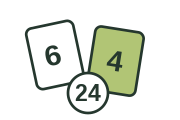
Put 2, 3, 5, and 9 on four slips. In Make 24, the goal is to use all four numbers exactly once, combining them with addition, subtraction, multiplication, or division. Leave the slips where both of you can reach them.
Suppose your child pushes the 9 and the 3 together: “That makes 12. We could double it.” It’s a promising idea. Doubling 12 would take a 2, and the 2 slip is right there. But that would leave the 5 unused. Give your child time to notice the spare slip. If they want a hint, ask, “What else can you make with the 9 and the 3?”
One answer is 9 − 3 = 6. The remaining slips give 5 − 2 = 3, which would make 18 if you multiplied. Another answer is 9 ÷ 3 = 3. Keep that 3 for a moment. Now the 5 can join it to make 8, but the remaining 2 only gets you to 16. Both routes are worth setting aside.
Here’s a move that opens a different path: 9 + 5 = 14. Subtract 2 to get 12, then notice that the remaining slip is 3, so this route also stalls. If you’re playing together, this is a good moment to let the other person take over.
Try making a 4 first: 9 − 5 = 4. The two smaller slips make 3 × 2 = 6. Put those results together and 4 × 6 = 24.
For a child who likes explaining why an idea nearly worked, those spare slips are part of the fun. For someone who is tired of arithmetic after school, a single clear signal in Quick Reaction might sound much more inviting tonight.
What if your first choice falls flat?
Listen to the request hidden in the complaint. “It disappeared too soon” is a reason to offer a puzzle that stays visible. “I don’t know where to start” is a reason to offer one clear action, such as pressing when the panel changes. “Let me make one for you” is an invitation to swap roles, whatever game you picked.
You can choose tomorrow’s Brain Minis game from what your child enjoyed about one turn today. At the end of one turn, ask “Which part would you like to do again?” A child who answers “making the code,” “catching your early tap,” or “finding the spare number” has given you a better guide to tomorrow’s choice than a score could.