My Child Gives Up After One Wrong Answer. What Can I Say?
When a child says “I’m bad at this,” it can be hard to know whether to help or give them space. Try three ways to respond, with a number puzzle you can play together.

Your child writes 7 + 5 + 4 + 2 = 18, looks at the target of 24, and pushes the paper away. “I’m bad at this.”
You can see how close they are. You’re about to say, “Try multiplying!” But your child has already put the pencil down.
One thing you can say here is “I got 18 for that line too. Want to see what I’d try with your 6, or would you like to leave it there?”
The 6 is the part they found when they added 4 and 2. Point to it as you speak. It gives your child something on the page they can come back to. What happens next depends on their answer.
If they want help, give one hint they can use
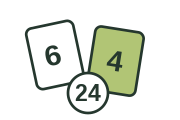
In Make 24 on Brain Minis, you get four numbers and one target. Can you use each number once to reach 24? You can add, subtract, multiply, or divide. For this puzzle, write 7, 5, 4, and 2 on separate slips so either player can move them.
Start with your child’s idea: slide the 4 and the 2 together and write 6 underneath. Then ask, “If we keep this 6, what would we need to multiply it by to reach 24?”
If they say “four,” let them look at the two remaining slips, 7 and 5. Those two alone won’t make 4 with one operation. Your hint has led to a dead end. That’s a useful moment for a grown-up to own: “Hmm. My idea used up the 4. I’m going to put it back.”
Now give your child the choice of which slip to save. If they set the original 4 aside, the remaining 7, 5, and 2 can make 6 another way: 7 − 5 = 2, but that leaves two 2s; 7 + 5 = 12, and 12 ÷ 2 = 6. Bring back the 4 and you have 4 × ((7 + 5) ÷ 2) = 24.
The moment worth noticing might come before the solution. “You decided to save the 4” tells your child exactly which decision opened up the puzzle.
If they want company, let them check your turn
Sometimes a child wants to stay at the table and has had enough of being the person who answers. Offer a different job: “I’ll move the slips. Will you check that I use every number exactly once?”
This works especially well when a number appears twice during a calculation. In the example above, one 6 came from 4 + 2 and another came from 12 ÷ 2. Ask your checker to point to the slips you used for each. They get to question your reasoning, catch a reused slip, or tell you to slow down. Let them finish checking even if you already know the arithmetic works.
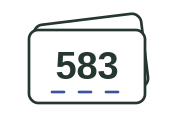
In a memory game, you can swap roles just as easily. Let your child write a short number, show it to you, and cover it. If you recall 583 as 538, hand them the pencil: “Which digits would you swap to fix my answer?” They get the pleasure of correcting you, and the round can end there.
If they want to stop, make stopping easy
Say “Okay. Shall I save the slips or clear the table?” Both answers are easy to act on. If they want to save the puzzle, leave the four numbers on a corner of the table. If they want it gone, put the slips away. An offer to stop feels more believable when it actually ends the round.
The next time you play Make 24 together on BrainMinis, decide who gets the first move and who gets to ask for a hint. Your child might choose to watch, check your work, or take the pencil back. Any of those choices gives you a place to begin.