


 Hints
Queens
Take your time. Find the next logical step.
How to play
- Place one queen in each row, column and region.
- Keep queens apart, including diagonally touching cells.
- Use marks to think, and undo whenever you like.
No sign-up. Just a little play.
A closer look at Queens
Rules and scoring
- Place exactly one queen in every row, column and lettered colour region. Your puzzle may be 6 × 6, 7 × 7, 8 × 8 or 9 × 9.
- Queens cannot touch, even at corners. Distant diagonal queens are allowed. Direct conflicts are marked without ending your puzzle or using hints.
- Choose Queen to place or remove a queen, Mark to add or remove a note, or Erase to clear a cell. Tab or arrow keys move focus; Enter or Space uses the selected tool. Undo reverses your last edit.
- Marks are optional notes and never change the rules. You do not need to mark empty cells to finish. Clear board restarts this same puzzle, keeping active time and any hints.
- Pause whenever you like. Only active solving time is recorded for your personal completion; there is no countdown or public leaderboard.
Try an example
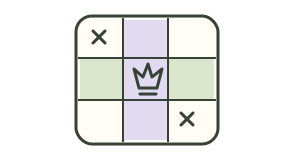
A queen in row 2, column 3 cannot have another queen in row 3, column 4, because those cells touch diagonally. A queen in row 4, column 5 is farther away, so the diagonal alone is allowed, provided the row, column and region rules also hold. Each lettered colour region must contain exactly one queen.
An approach to try
Begin with a small region or a row with few available cells. After placing a queen, consider its row, column and the eight neighbouring cells before moving on. Marks are optional notes, not a requirement for completion. Distant diagonal queens are allowed, unlike the usual chess-queen attack rule. Direct conflicts are explained without ending the puzzle or using a hint.
Play for a challenge or a short break. Results describe a game, not your intelligence or cognitive health. You can play available Minis as a guest; signing in lets you keep confirmed saved results.