


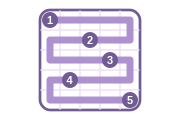
Number Trail
Draw a path through every square once, visiting numbered cells in order. Race through 12 puzzles and aim for the fastest total time.
No sign-up. Just a little play.
How to play
- Start at 1 and connect the numbers in order.
- Cover every square once, then finish at the largest number.
- Race through 12 puzzles. Your fastest total time wins.
A closer look at Number Trail
Rules and scoring
- Begin at number 1. Move to a horizontally or vertically adjacent cell, passing numbered cells in order. Your puzzle may be 5 × 5, 6 × 6, 7 × 7 or 8 × 8.
- Do not cross walls, jump cells, move diagonally or reuse a cell. Enter the largest number only after covering every other cell; it cannot be used as a shortcut through the board.
- Drag with your finger or mouse, or tap cells one at a time. Tap an earlier part of your path to roll back to it. Undo reverses your last edit. Tab or arrow keys move focus; Enter or Space selects a cell.
- An illegal step leaves your valid path intact and explains why for free. A legal move into a dead end is left for you to work out. You can always backtrack.
- Complete all 12 puzzles to set your total time. Puzzles 1–4 are Easy, 5–8 Medium and 9–12 Hard. Every player and replay uses the same published set and order.
- The clock starts with puzzle 1 and stops when puzzle 12 is checked. Menus, rules, background time, reloads, reconnects and puzzle transitions all count. There is no pause or skip.
- You have 2 hints for the entire race. Undo and Clear board keep the same puzzle, completed count, elapsed time and used hints. A completed puzzle advances automatically.
- Only completed 12-puzzle races enter the leaderboard. Your fastest total time is your personal best; equal times share a rank. Sign in to save guest results within 30 minutes.
Try an example
Start at 1 and build one continuous path through adjacent squares. You must reach 2 before 3 and visit every square exactly once. Reaching the largest number while empty squares remain is not a valid finish: it is the endpoint, not a passage through to another area. Diagonal moves, reused squares and steps across walls are not allowed.
An approach to try
Look for corners and narrow areas that could become cut off by your path. A legal step can still lead to a dead end, so consider where you will leave each area before filling it. Tap an earlier part of the path to backtrack, or use Undo. Illegal moves leave your valid path intact and explain the problem without using a hint.
Choose the next step without cutting the path short
| Column 1 | Column 2 | Column 3 | Column 4 | Column 5 | |
|---|---|---|---|---|---|
| Row 1 | 1 | · | 2 | ✓ | Empty |
| Row 2 | Empty | Empty | Empty | × | Empty |
| Row 3 | Empty | Empty | Empty | Empty | Empty |
| Row 4 | Empty | Empty | Empty | Empty | Empty |
| Row 5 | Empty | Empty | Empty | Empty | 3 |
- From 1, move right twice to reach 2. You have visited three of the board’s 25 cells. Moving one more cell right to ✓ is legal; moving diagonally to × is not.
- A legal step does not prove that the rest of the route will work. Keep a way into and out of every unvisited area. Backtrack if a path would leave a square isolated.
- One way to finish this wall-free example is to complete the top row, snake left across row 2, right across row 3, left across row 4, then right across row 5 to reach 3 last. Entering 3 while any square is still unvisited would end the path too early.
Play for a challenge or a short break. Results describe a game, not your intelligence or cognitive health. You can play available Minis as a guest; signing in lets you keep confirmed saved results.